

Most speech data is read aloud
Someone sits with a script and reads prompts into a mic. Clean, fast, and nothing like the way people actually talk.
Built on our own data, recorded across Nigeria.
Backed by the TY Danjuma Family Office
We didn't scrape it off the internet. We went out and recorded it. Every hour is consented, paid for, and checked by somebody who actually speaks the language.
Anybody can build a model. Nobody can go back and record the last three years.
1,400 hrs
Recorded speech
Studio and field, across the country.
3,200
Distinct speakers
No speaker recorded twice under two names.
24
States covered
Out of 36, plus the FCT.
18
Accents and varieties
Tagged per clip, not per session.
The language of the courts, the classroom and the news. It has its own vowels and its own rhythm, and no model trained on London or Los Angeles has heard them.
60–100M
Speakers
37
States and the FCT
820 hrs
Recorded so far
Spoken everywhere, native here. Pidgin learned first sounds nothing like Pidgin spoken over Yorùbá or Hausa, and the difference shows up in the audio.
75–120M
Speakers
6
States in the heartland
580 hrs
Recorded so far
Tone carries meaning, not mood. Get the marks wrong and you have written a different word. Most speech pipelines drop them entirely.
40–45M
Speakers
6
States in the zone
Planned
Collection
Count second language speakers and it is the biggest language in the country. It runs trade and radio across the whole north.
50–55M
First language speakers
7
States in the zone
Planned
Collection
Tonal, heavily dialectal, and written with marks most speech tools quietly throw away. Anambra and Abia do not sound alike.
25–35M
Speakers
5
States in the zone
Planned
Collection
Nigerian English, Every zone
The recordings are the hard part. These are what they make possible.

Speech to text: Nigerian English and Pidgin, first time of asking.

Voice interfaces: Products that answer back in a voice people recognise.

Datasets: Licensed hours you can train on, labelled clip by clip.

Collection on demand: Your domain, your users' accents. We record it.
Showing Speech to text and the 2 after it, of 4
Most speech data is somebody reading prompts out loud. Ours is people talking. That difference is the whole product.
Someone sits with a script and reads prompts into a mic. Clean, fast, and nothing like the way people actually talk.
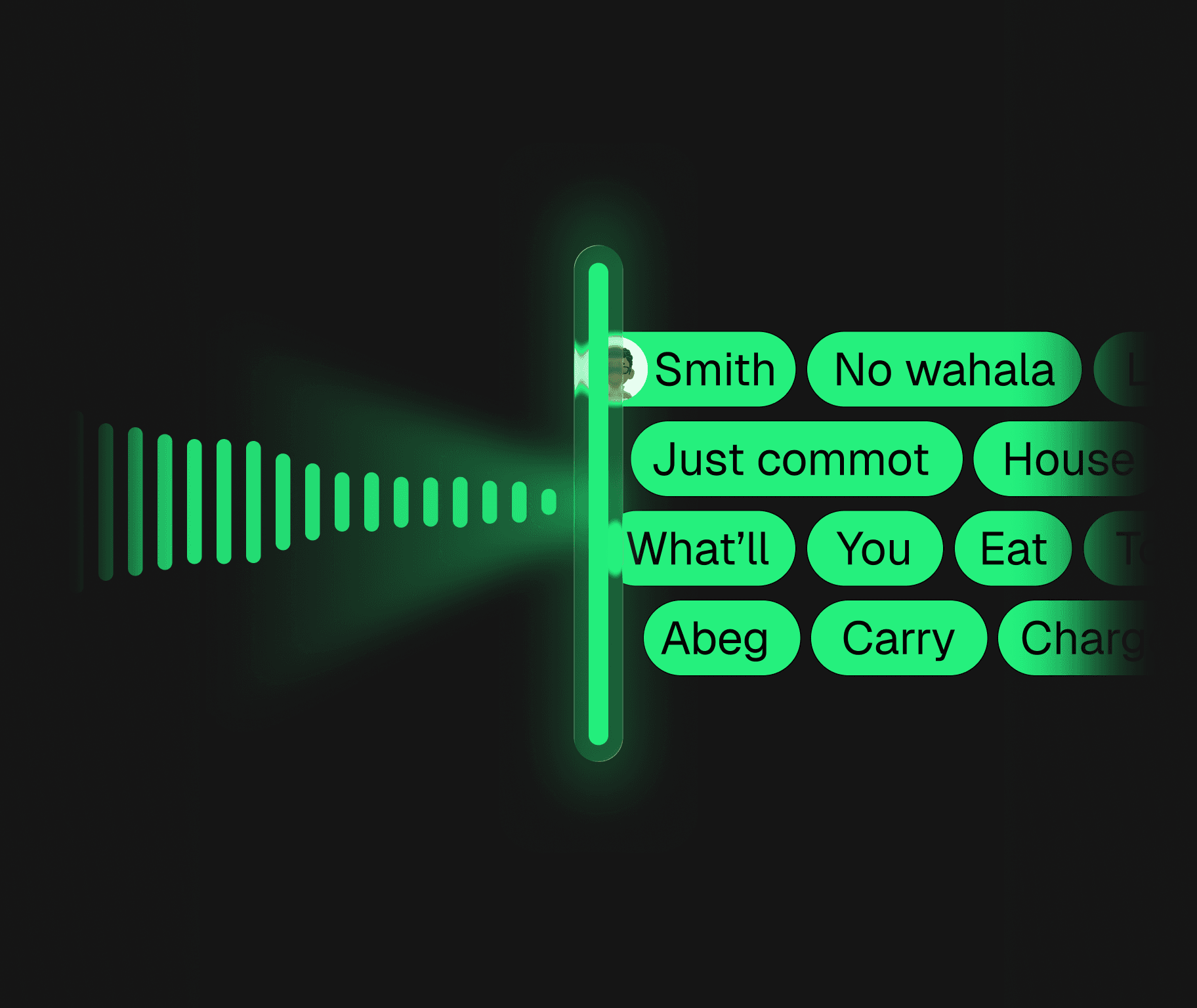
Reading evens out the pace, drops the fillers, and never switches from English to Pidgin halfway through a sentence.
People talking to each other, in the places they would be talking anyway, with the noise that comes with it.
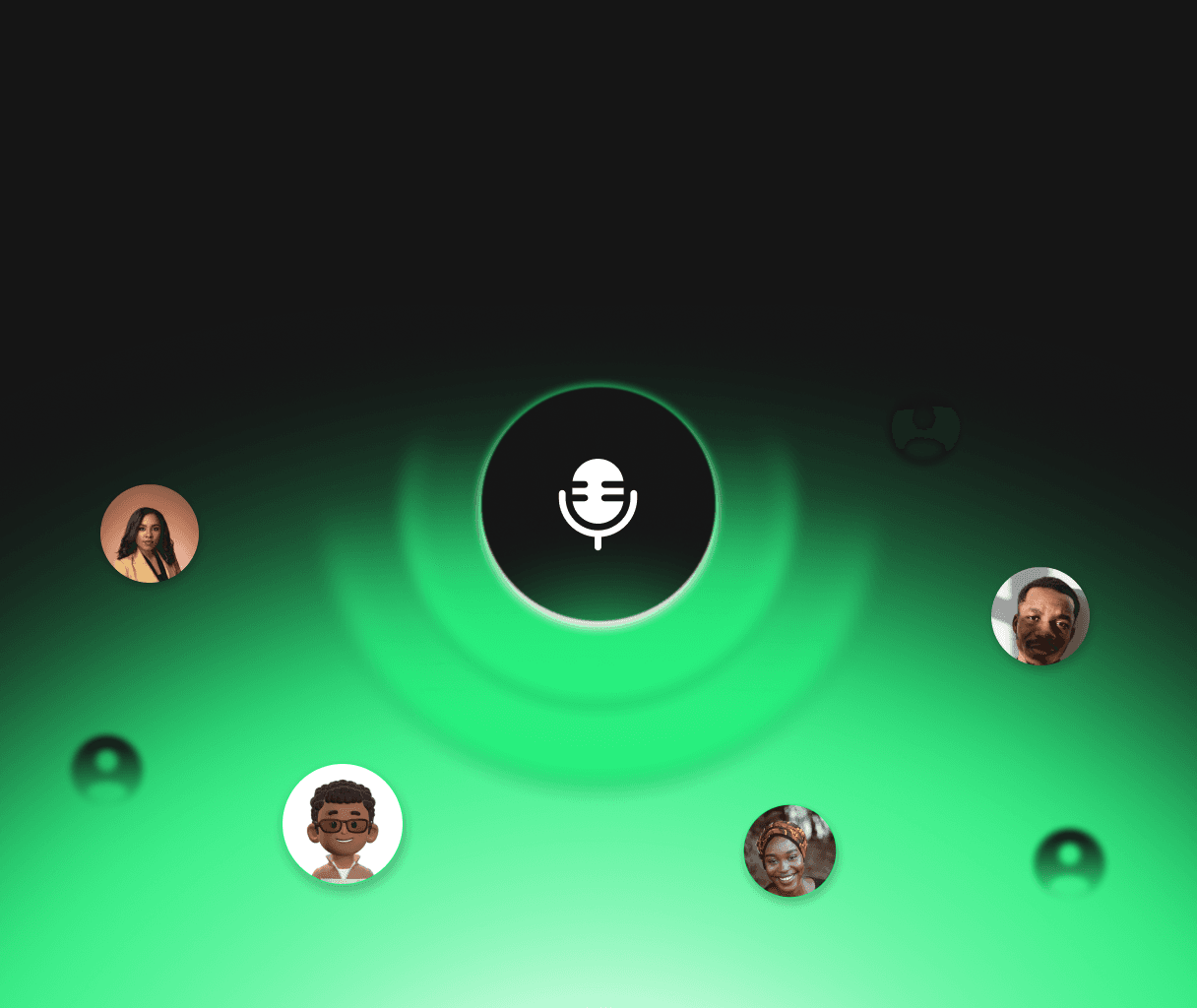
Everyday African speech, in the languages and the registers it actually happens in.
Three of them, all trained on the same corpus. Pick one to see what it does.
Transcription you can build on. Subtitles, meeting records, anything that has to be searchable after the fact.
Generated audio in a voice your customers already recognise, rather than one imported from somewhere else.
End to end conversation. Somebody speaks, the thing answers, and nothing has to be written down in between.
Speech to text
ASR, Speech to text. Transcription you can build on. Subtitles, meeting records, anything that has to be searchable after the fact.
The ones that come up on nearly every call. If yours is not here, ask us directly.
Nigerian English and Nigerian Pidgin are collected and in use. Yorùbá, Hausa and Igbo are next, in that order. If you need one that is not on the list, that is a conversation worth having.
We record it ourselves, across Nigeria. Every hour is consented, paid for, and checked by somebody who speaks the language. Nothing here was scraped.
Yes. Licensed hours, labelled clip by clip rather than batch by batch, with provenance you can put in front of a regulator.
That is a service we run. Your vocabulary, your customers' accents, recorded to a brief you write with us.
We scope it, run a pilot on your own domain data, then deploy. You see the numbers on your traffic before anybody signs anything long term.
Yes, and you get paid for it. Bring your voice, your accent and an hour of your time.